

YOUR CART IS CURRENTLY EMPTY
Exhibition wall graphics: fabric vs vinyl
Published
Quick answer
For indoor exhibition walls, dye-sublimated fabric is usually the better choice: it has a low-glare finish under hall lighting, folds into a carry bag and can be washed. Vinyl (PVC) banner material suits outdoor use, because properly made PVC resists moisture and UV. For shell scheme walls you can also use printed laminated panels that fold for transport. If the venue wall can't be relied on, bring your own free-standing fabric wall.
Fabric or vinyl: which suits exhibition wall graphics?
Most stand walls are seen indoors, at close range, under strong overhead lighting, and they travel to more than one show. Those conditions favour fabric. Vinyl comes into its own outdoors.
| Factor | Dye-sublimated fabric | Vinyl (PVC) banner |
|---|---|---|
| Finish under hall lighting | Low glare; colour sits in the fibres | Gloss can reflect; a matt finish reduces glare |
| Typical weight | 270gsm polyester (our SuperWall skin) | Varies by the PVC product; check the actual specification |
| Packing | Folds into a carry bag | Usually rolled to avoid creases |
| Cleaning | Machine wash cold | Ask us for care advice |
| Changing the message | Swap the skin, keep the frame | Usually a new print |
| Outdoors | Check with us first | Resists moisture and UV when properly made |
| Sustainability | Water-based dyes; fabric from recycled PET | Ask about the material spec |
Colour and glare under hall lighting
Stand graphics are usually seen up close under artificial light. A shiny surface reflects that light back at the visitor, which makes the graphic harder to read from some angles.
In dye sublimation, heat and pressure turn solid dye straight into a gas. The heat opens the pores of the fabric, the dye enters, and the pores close around it as the fabric cools. Because the colour ends up inside the fabric rather than as a coating on top, the finish is low-glare, true to colour and resistant to fading.
With vinyl, the finish matters. Gloss PVC gives saturated colour but reflects light. Matt PVC cuts reflective glare, so it is the better pick for indoor displays seen up close under artificial light.
Durability, creasing and cleaning
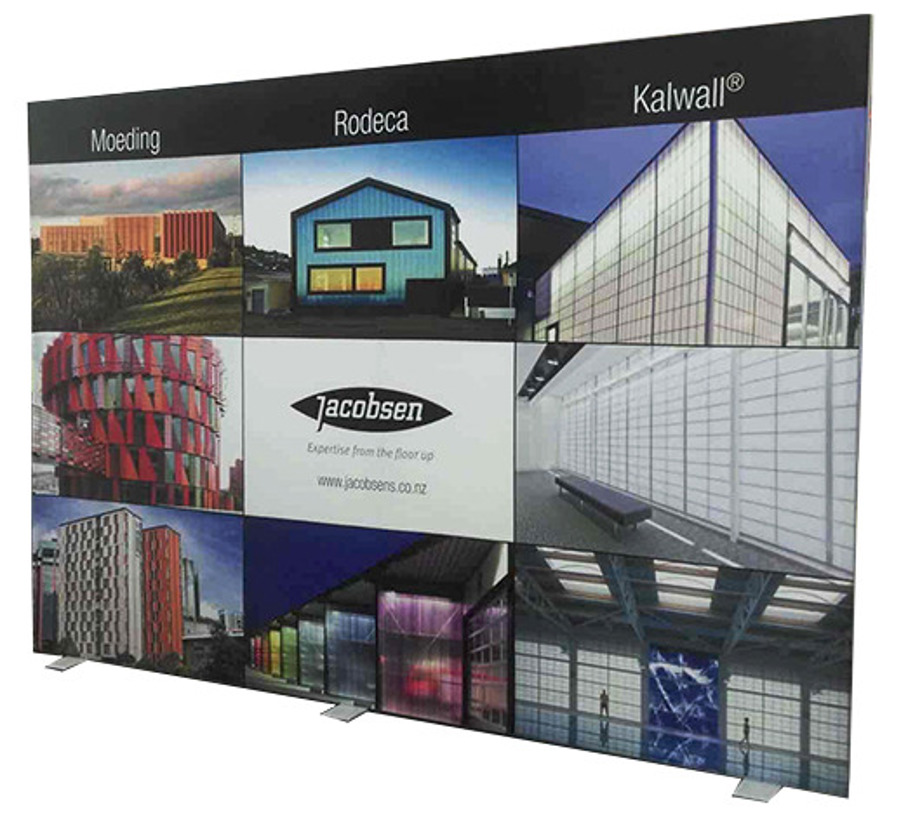
Tension is what keeps fabric smooth. On a SuperWall, the one-piece skin slides over an aluminium frame and zips closed, which pulls the fabric taut and crease-free. A Brandframe works differently: a silicone strip along the edge of the print pushes into the frame, holding the face flat and tight. That edge is what "SEG" (silicone edge graphic) refers to.
Our dye-sublimated fabric graphics can be stretched, folded and machine washed cold. The SuperWall skin is a hard-wearing, machine-washable polyester with double-stitched seams.
PVC banner is made to bend and roll without cracking, so it is normally rolled for transport rather than folded.
Weight, packing and freight
Weight depends on the exact product, so compare specifications rather than material names. Our SuperWall skin is 270gsm, but PVC banners come in several grades. Fabric may be lighter than a heavy outdoor PVC banner; that is not a rule for every banner. Ask for the weight of the proposed print and allow for the complete frame, not just the graphic.
The bigger freight difference is how each material packs. Fabric folds, so a large graphic goes into a bag. Vinyl is rolled, so a long banner needs a long tube or box.
A complete SuperWall, with frame, fabric graphic and carry bag, weighs 7 to 14kg depending on size, and one person should be able to put it together in less than 10 minutes. For shell scheme walls, a full set of wall graphics for a 6m x 3m stand fits into two carry bags.
Reprint cost and changeover
If the same stand goes to several shows a year, the frame is the long-term asset and the graphic is what changes. A fabric skin on a SuperWall slides off and a new one slides on. With a Brandframe, the print is the part you replace, so a new message usually means a new skin while the frame stays. Laminated wall panels can be reprinted one panel at a time if your message or brand changes.
Outdoor use and weather
PVC sheds water, and a well-made banner holds up against tearing, moisture and UV through long periods outside. That's why it is widely used for outdoor banners, scaffolding banners and building wraps.
Our SuperWall is listed for heavy-duty indoor use. Dye-sublimated fabric is colour-fast and UV-stable, but wind and rain are a different matter. For outdoor sites, an optional outdoor water base adds stability to a SuperWall on grass, bitumen or pavers, but we don't publish a wind rating for it. We work with you to supply PVC banners as well as fabric graphics. Tell us about the site and we'll recommend the graphic and base that suit it.
Sustainability: dye-sub fabric
Dye sublimation prints with water-based dyes, not solvent-based inks, so it avoids the volatile organic compounds (VOCs) that some print methods give off. The process itself uses no water, so nothing runs off into waterways, and prints are dry as they leave the printer, which removes a power-hungry drying step. The SuperWall graphic fabric is 85% recycled polyester, made from recycled PET bottles. Read more about dye-sub printing.
Four ways to cover your stand walls
There are four common ways to cover the walls of a shell scheme stand. All four were covered in the first version of this page; here is where each stands now.
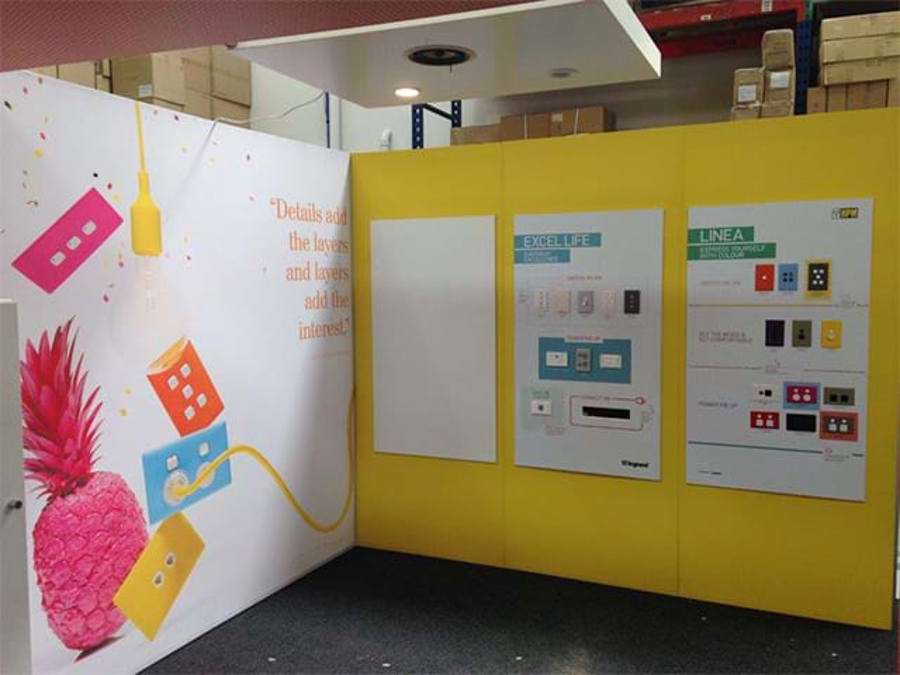
1. One-piece fabric wall graphic. A single fabric graphic covers each wall section, with no seams or joins. Velcro on the back attaches it to carpeted shell scheme walls. For smooth walls, it comes with mounting blocks. Some shows ban Velcro, so check your exhibitor manual first. Unless you ask for another size, graphics are finished at 2.35m high to suit 2.4m high shell scheme walls. Some shows use 2.5m walls, so check the height too. The weak point is that it depends on the venue supplying a wall. This is the fabric option in our Graphics 2 Go wall graphics.
2. Folding laminated panels. Panels are printed in 1m-wide sections, sealed with a non-glare, scratch-resistant laminate and slit so they fold in half for transport. They are trimmed to line up into one image across the wall. Choose this option for photographic print quality.
With either option, fitting the graphics to a 3m stand with carpeted shell scheme walls should take one person no more than 20 minutes.
3. Roll-up wall panels. These are like the laminated panels, also in 1m sections, but rolled rather than folded. The original version of this page noted they had been largely replaced by other options because they are more awkward to handle. A rolling wall-mounted option is still listed on the Graphics 2 Go page, so ask us if you need one.
4. A free-standing fabric wall you bring yourself. This is the SuperWall fabric wall: a self-supporting aluminium frame with a one-piece dye-sublimated skin. It can stand in front of a shell wall or, where the organiser permits independent wall structures, help form the walls of a 3m x 3m stand, so you needn't rely on venue-supplied walls. Standard widths include 2.4m, 3m and 6m; a 1m width can be made as a custom build. The standard display height is 2.25m, with 1.5m-high versions for shopping centres. It is priced from $1,467 excluding GST and freight, with a standard production time of 1.5 weeks from order and print-ready artwork.
For a framed look on a stand, Brandframe SEG fabric frames come in floor-standing, hanging, exhibition and travel formats.
What do wall graphics for a shell scheme stand cost?
Graphics 2 Go wall graphics start from $1,063 excluding GST and freight, in fabric or folding laminated board, for 3m x 3m and 6m x 3m stands. The standard production time is 1.5 weeks from order and print-ready artwork. Allow extra time for freight. A single set can be reused over multiple shows.
Next step
Compare the options on our exhibition wall graphics page. Then send us your stand size, show dates and artwork through the enquiry form, or call 1300 240 250, and we'll recommend the graphic that suits your walls. You can also see the options at our Artarmon showroom (visits by appointment). For our fabric-printing capabilities, see printing and production.