

YOUR CART IS CURRENTLY EMPTY
What wins Best Stand at trade shows
Quick answer
Best Stand judges reward a clear idea that visitors understand at a glance, strong visual impact, quality materials and finish, a layout people can move through easily, and staff who engage. Many award programs judge stands against others of a similar size, so a well-executed small stand can win. Read your show's published award criteria first, then build them into your stand brief.
How Best Stand awards are judged
Organisers publish their own criteria, and they differ from show to show. Some use a judging panel. Others let attendees vote: at Sydney Build Expo 2026, attendees and speakers were asked which stands stood out most. At Melbourne Build Expo, every exhibitor is entered automatically, and stands are marked on "design, atmosphere, engagement and the general vibe".
All three programs below split stands by size, so you compete against stands like yours.
| Show (organiser's published terms) | Size categories | Other categories |
|---|---|---|
| AGHA Melbourne Gift Fair 2026 | Small (2 x 2 to 6 x 3), Medium (6 x 3 to 12 x 6), Large (12 x 6 and above) | Best New Stand, for first-time exhibitors |
| IBC 2026 Best Stand Design Awards | Under 20sqm, up to 100sqm, over 100sqm | Judges Innovation Award, any size |
| Sydney and Melbourne Build Expo | Above 36sqm, below 36sqm | Stand Design, Engagement, Newcomer, Exhibitor Marketing |
The criteria themselves overlap a great deal. Here is what two judged programs ask their judges to assess:
| AGHA Melbourne Gift Fair 2026 | IBC 2026 Best Stand Design Awards |
|---|---|
| Originality of design; visual impact | Visual appeal: colour, lighting, a "wow" factor, something unique |
| Cohesive, memorable messaging that matches the brand | "Does what it says on the tin": is it clear what the company sells? |
| Use of space, functionality, product placement | Use of space: can visitors move "freely and logically"? |
| Effective use of materials; colour, texture, lighting, graphics | Other considerations: accessibility and sustainability |
The sections below take each theme in turn.
A clear idea visitors get instantly
IBC's judges ask whether you can tell what the company does from the stand alone, whether the branding is "clearly visible from all available approaches", and whether it is "immediately clear what the exhibitor is selling". AGHA looks for messaging that matches the rest of the brand's communications.
In practice, that means one idea, expressed through the structure as well as the graphics:
- Give the main message the greatest prominence and keep supporting detail close to the product it describes.
- Put your brand where every approach can see it, including from the back and sides on an island or peninsula stand.
- Cut copy that staff or a linked page can explain better.
- Test the design at the expected viewing distance, with people, counters and stock in the way.
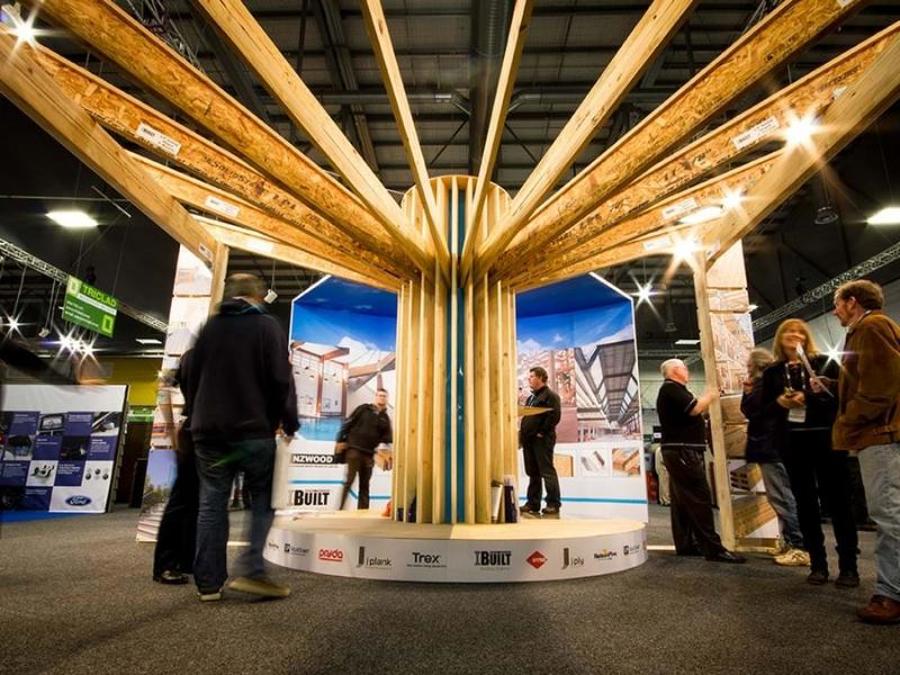
On the NZWood stand above, the product is the architecture. The timber structure shows the material at full size before a visitor reads any copy, and with no closed walls, visitors can enter from any side.
Visual impact: colour, lighting and originality
Both judged programs ask about colour and lighting by name. IBC asks whether colour has been used "in a focused, refined and strategic manner" and whether lighting creates "a memorable experience". AGHA lists originality, visual impact, and the use of colour, texture, lighting and graphics.
Originality doesn't have to mean expense. A single strong feature, used with restraint, reads better from the aisle than a stand where every surface competes. Plan lighting with the structure from the start rather than adding it late.
Build quality and finish
AGHA judges "effective use of materials". Judges see the stand up close, so seams, edges, graphic joins and cable runs all count.
- Pre-build before the show. A test build shows up poor joins and finishing problems while there is still time to fix them. We assemble and check each custom stand in our workshop before it ships, so problems are found there rather than at the venue.
- Hide the working parts. Plan storage, power and cable routes in the design, not on the morning of bump-in.
- Show your reuse plan. IBC asks whether efforts have been made toward sustainability, such as "repeated use of materials from previous years". A reusable structure with fresh graphics answers that directly.
Visitor experience and use of space
IBC asks whether visitors can move "freely and logically" through the stand and whether the space holds everything the exhibiting experience needs, such as meeting areas, product demonstrations and refreshments. AGHA scores functionality, product placement, visual merchandising and product accessibility.
- Map how visitors, staff and stock will move before you approve a layout.
- Give people a reason to stop and a place to talk.
- Keep the entry open. IBC asks judges to note efforts on accessibility, giving "avoiding a step up or into the space" as an example.
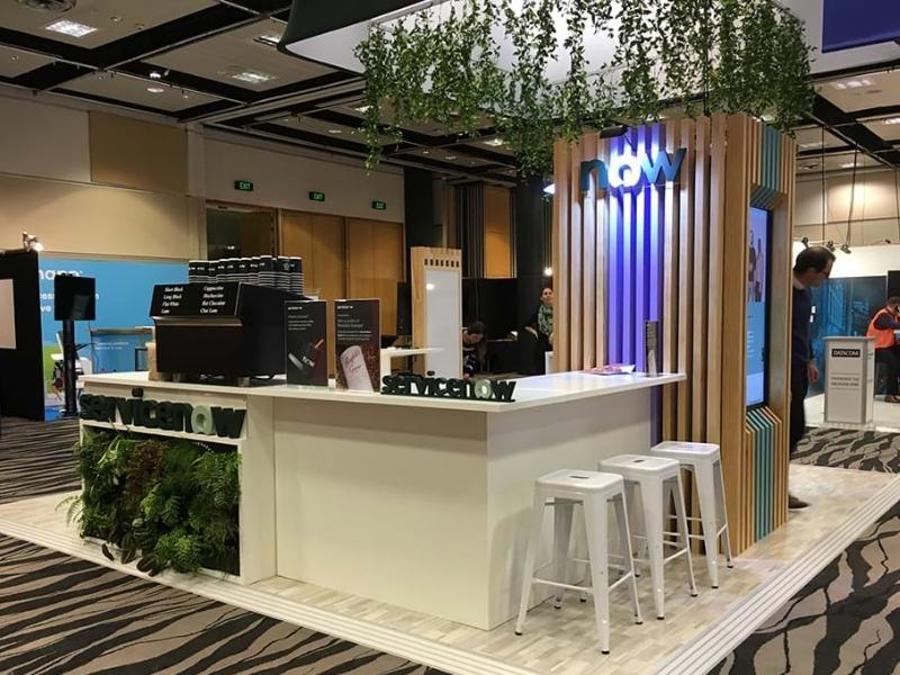
The ServiceNow stand above uses a coffee bar to give visitors an easy reason to stop and sit, with the brand on a lit timber column beside it.
Staff and engagement
A stand is judged as a working space, not an empty set. Melbourne Build Expo marks engagement, atmosphere and "general vibe", and runs a separate Best Engagement award. A team that draws people in from the aisle, rather than waiting to be approached, shows the stand working as it should.
- Roster enough people for peak times, without crowding the space, and keep the stand staffed for the whole show. You may not know when judges will visit.
- Split roles: one person greets and draws people in, another runs demonstrations or captures leads.
- Brief every staff member on the stand's one main message.
Briefing your builder for an award
Treat the award criteria as part of the brief, not an afterthought. Download your show's award terms, note your size category, and ask your designer to show how the concept answers each criterion. Our guide to writing a winning stand brief covers the full process. At minimum, the brief should:
- Define the audience and the action you want visitors to take.
- Confirm floor space, open sides, height limits and venue rules.
- List demonstrations, products, screens, storage and hospitality needs.
- Map visitor, staff and stock movement.
- Prioritise messages before graphics are developed.
- Set the budget, lead time, reuse plan and freight expectations.
Allow time. A typical custom build needs six to eight weeks between brief sign-off and the show. Roughly two of those weeks go to concept and 3D renders and three to four to manufacturing and graphics, with freight and installation after that. Simpler stands can be turned around faster. See how our custom exhibition stands are designed, built and installed.
Common mistakes that cost points
- Starting with a visual style before defining the objective.
- Filling every wall with copy.
- Treating storage, power and cable routes as late additions.
- Approving a layout without testing visitor flow.
- Leaving the stand short-staffed during quiet periods.
Frequently asked questions
What makes an award winning exhibition stand design? A clear idea, strong visual impact, good materials and finish, easy movement through the space and engaged staff. Check your show's own criteria, as they vary.
Can a small stand win Best Stand? Yes. Many programs judge by size. AGHA's Best Small Stand category starts at 2 x 2, and IBC has a category for stands under 20sqm.
Do I need to enter a Best Stand award? It depends on the show. Melbourne Build Expo enters every exhibitor automatically. Other shows may ask you to register or nominate, so check the exhibitor manual or award page early.
Should the stand be hired or purchased? If you only exhibit at one or two shows a year, or want to trial a show, hiring avoids the capital cost. If you exhibit at several shows a year, owning a custom stand gives you a presence that is distinctly yours, and we can store it and prepare it for each show. Compare the full cost across your show calendar.
Next step
Aiming for Best Stand? Brief us early. Our design and build team handles concept, 3D renders, manufacturing, freight and installation from one brief. Send your show, stand size and award category through our contact page or call 1300 240 250.
About the author
Displays 2 Go